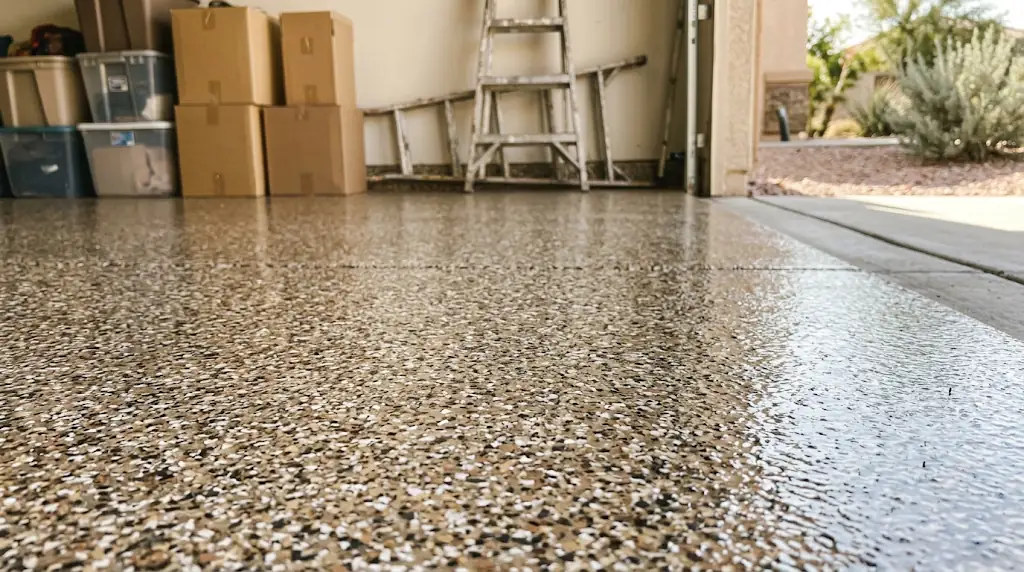
A professional epoxy flooring installation in a Phoenix West Valley garage requires two to three consecutive days to complete. Extreme desert temperatures necessitate a phased chemical application, utilizing a slow-curing penetrating epoxy primer on day one followed by a UV-stable polyaspartic topcoat on day two.
The timeline of a garage floor coating is dictated entirely by the chemical curing requirements of the industrial resin and the structural condition of the underlying concrete slab. DIY paint kits and aggressive sales teams frequently advertise immediate 24-hour turnaround times. In the extreme climate of Maricopa County, rushing the installation process guarantees premature delamination. Achieving a permanent, structural bond requires a strict, multi-day schedule that respects the physics of heated concrete and the cross-linking cycles of industrial polymers.
Standard West Valley Installation Schedule
A standard two-car garage requires a systematic approach. Assuming the concrete does not require massive structural reconstruction or deep moisture vapor mitigation, a professional installation follows this rigid timeline:
| Project Phase | Estimated Time | Process Description |
| Day 1: Profiling | 4 to 6 Hours | Heavy planetary diamond grinding, crack routing, and dust evacuation. |
| Day 1: Base Application | 2 to 3 Hours | Rolling of 100% solids epoxy primer and full broadcast of decorative flakes. |
| Overnight: Primary Cure | 12 to 16 Hours | Material undergoes exothermic reaction to wick deeply into the concrete pores. |
| Day 2: Armor Topcoat | 2 to 4 Hours | Scraping excess vertical flakes, vacuuming, and applying the polyaspartic clear coat. |
| Day 3: Return to Service | 24 Hours Later | Floor reaches sufficient chemical hardness to support 5,000-pound vehicle traffic. |
The Danger of “One-Day” Installations in the Desert
Many national franchises aggressively market “one-day polyurea” floors. This involves applying a fast-curing polyurea or polyaspartic base coat directly to bare concrete, immediately broadcasting flakes, and sealing it a few hours later. While this works in freezing northern climates, it is a structural liability in Arizona.
During a typical July afternoon in Peoria or Glendale, the surface temperature of a garage slab near the driveway apron can easily exceed 130°F. When rapid-curing polyaspartic resins hit concrete at these extreme temperatures, the material “flash cures.” It hardens instantly on the surface before it has the physical time to sink into the microscopic voids of the concrete. This creates a weak surface-level adhesion rather than a deep mechanical bond. When heavy, hot tires turn on this surface, the floor inevitably peels. Taking an extra day to use a slow-curing epoxy primer prevents this catastrophic failure.
Phase 1: Mechanical Concrete Profiling (4 to 6 Hours)
The clock on the installation does not start with pouring chemicals; it starts with heavy machinery. Professional crews spend the majority of the first day physically grinding the concrete.
Contractors utilize 800-pound planetary diamond grinders to remove the smooth, troweled top layer of the slab. The goal is to achieve a Concrete Surface Profile (CSP) of 2 or 3, a standard metric established by the International Concrete Repair Institute. This profile resembles the texture of medium-grit sandpaper, exposing the open pores of the concrete matrix so the liquid epoxy has a physical structure to grip.
During this phase, installers also chase and repair existing cracks. The expansive clay soils common in Surprise and El Mirage cause heavy slab settlement. All stress fractures and expansion joints are routed out with a V-blade grinder and packed with industrial polyurea joint filler.
Phase 2: The Base Coat and Flake Broadcast (2 to 3 Hours)
Once the concrete is ground, vacuumed, and patched, the chemical application begins. Installers mix a two-part, 100% solids epoxy. Unlike fast-curing materials, this industrial epoxy has a long “pot life.”
The slow curing time is exactly what is needed in the desert. The epoxy remains in a liquid state long enough to be pulled downward by gravity into the newly opened pores of the concrete slab. As it slowly hardens overnight, it creates physical resin roots inside the concrete. Once the liquid is laid down, installers broadcast hundreds of pounds of colored vinyl chips into the wet resin until the floor is completely covered, providing structural thickness and impact resistance.
Phase 3: The Polyaspartic Clear Coat (Day 2)
Installers return on the morning of the second day. At this point, the epoxy base coat has cured into a permanent, rock-hard layer. The crew uses flat metal blades to aggressively scrape the entire floor, knocking down any jagged vinyl flakes standing on edge.
After a final vacuuming, the floor is sealed with a polyaspartic aliphatic urethane topcoat. This specific topcoat chemistry is mandated for the West Valley because it is 100% UV stable and completely resistant to the plasticizers found in boiling hot vehicle tires. The polyaspartic cures exceptionally fast in the heat, usually becoming dry to the touch within a few hours.
Official Return to Service Timelines
While the installation crew finishes the physical work on the second day, the floor is not immediately ready for heavy use. The polyaspartic topcoat must undergo its final cross-linking process to achieve maximum chemical and scratch resistance.
- Foot Traffic (4 to 6 Hours): You can safely walk on the floor in socks or clean, soft-soled shoes later the same evening.
- Light Items (12 to 24 Hours): Trash cans, lightweight shelving, and standard garage boxes can be gently moved back into the space.
- Heavy Traffic (24 to 48 Hours): Vehicles, heavy tool chests, and workout equipment must remain off the floor for a full one to two days following the final topcoat application, depending on ambient humidity and temperature.
Local Code and HOA Considerations
Installation timelines can occasionally be extended by local municipal codes or Homeowners Associations (HOAs). Communities like Sun City and Sun City West frequently enforce strict noise ordinances and specific contractor working hours. Because planetary diamond grinders and high-CFM vacuums generate significant industrial noise, crews must often pause operations by mid-afternoon, pushing the final preparation steps into the following morning.
Never compromise the permanent structural integrity of your home for the convenience of a fast installation. High-heat desert environments demand heavy mechanical preparation and multi-day chemical curing cycles. Secure a surface built strictly for the extreme conditions of Maricopa County by contacting Surprise Epoxy Flooring. Visit our contact page to schedule a precise site evaluation and lock in your installation dates.