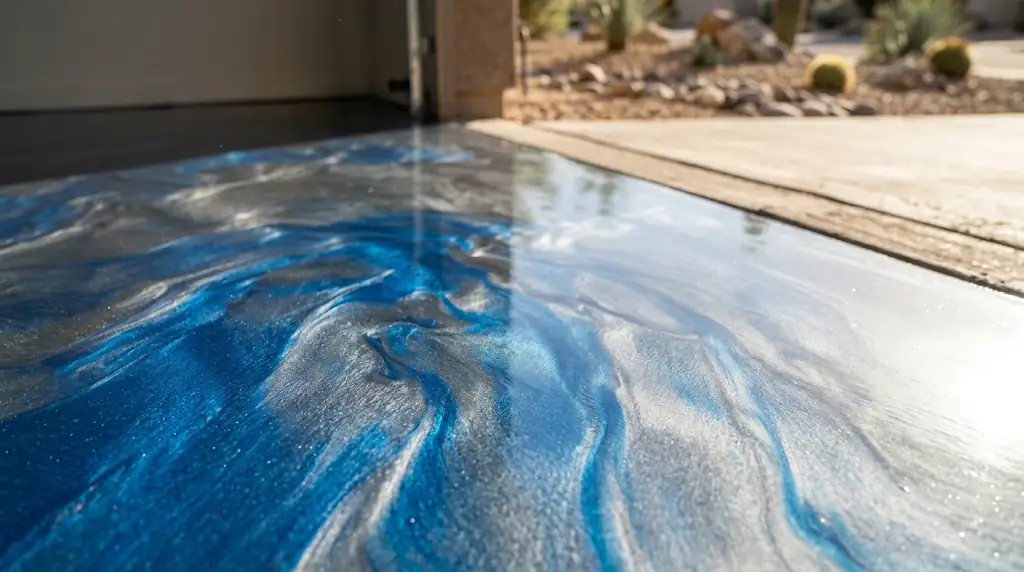
The best time of year to install epoxy flooring in the Phoenix West Valley is during the spring (March to May) and fall (October to November). During these months, average daytime temperatures stay between 75°F and 95°F with low humidity, allowing industrial-grade resins to cure flawlessly without heat acceleration.
Many DIY epoxy kits and aggressive salespeople claim you can install floor coatings year-round in Arizona without any issues. This is a flawed assumption. While professional installers can adapt to weather extremes using specialized chemistry, the physical environment heavily influences how chemical resins bond to concrete. The ambient air temperature and the concrete surface temperature are rarely the same, and ignoring this distinction leads to bubbling, peeling, and premature failure.
The Chemistry of Curing in the Desert
Epoxy and polyaspartic coatings do not “dry” like standard house paint; they cure through a highly sensitive, heat-driven chemical reaction called an exothermic process. The speed and success of this reaction are dictated entirely by temperature and moisture.
When you mix the two components of an epoxy system (the resin and the hardener), the clock starts. The amount of time the installer has to pour, spread, and roll the material before it begins to harden in the bucket is called the “pot life.”
- Optimal Pot Life: At 75°F, a standard industrial epoxy offers roughly 30 to 40 minutes of working time. This allows the material to penetrate the microscopic pores of the mechanically ground concrete.
- Flash Curing: For every 10°F increase in temperature, the pot life is cut in half.
- Viscosity Changes: Heat makes the resin thinner, while cold makes it thick and difficult to spread, similar to cold syrup.
Summer Installations: The Heat Acceleration Problem
The Phoenix West Valley experiences brutal summer conditions. The hottest month is July, with an average high of 106°F and an average low of 85°F. June and August also regularly average above 104°F.
Applying standard epoxy to a Sun City West garage floor in July is highly risky. The concrete slab acts as a massive heat sink. Even if the air temperature inside the garage is 100°F, the concrete surface temperature near the driveway apron can exceed 130°F. When liquid epoxy hits a slab that hot, it “flash cures.”
The resin hardens before it has the physical time to seep into the concrete matrix, resulting in a weak mechanical bond. Furthermore, the rapid off-gassing of the curing resin can trap air bubbles beneath the surface, creating a porous and brittle finish.
If an installation must happen in the summer, professionals do not use standard epoxies. Instead, they shift to slow-cure primers or specific polyaspartic formulations mixed with specialized retarders, and they typically begin work before sunrise to utilize the lowest ambient temperatures of the day.
Monsoon Season: The Threat of Moisture and Blushing
The period from July through September brings the Arizona monsoon season. While the West Valley is generally arid, with humidity dropping as low as 19% in June, monsoon storms introduce sudden spikes in atmospheric moisture.
Humidity is a known enemy of raw epoxy. If the moisture levels in the air are too high while the floor is curing, a chemical reaction occurs at the surface level, resulting in “amine blush.” This blush manifests as a greasy, hazy, or white film on the top of the epoxy coat. If a clear topcoat is applied over an amine blush, it will inevitably delaminate. Professional crews meticulously monitor dew points and ambient humidity, often running heavy-duty dehumidifiers during late-summer installations to ensure a bone-dry curing environment.
Winter Installations: Cold Slabs and Sluggish Chemistry
Winters in the West Valley are mild compared to the rest of the country, but they present unique challenges for chemical coatings. The coldest month is December, with an average low of 46°F and a high of 66°F.
When the concrete slab temperature drops below 55°F, traditional epoxy resins become highly viscous. They resist flowing out smoothly and struggle to penetrate the concrete profile. The curing process slows down dramatically. A floor that takes 24 hours to cure in October might take 72 hours to reach the same hardness in January.
To counteract this, professional installers use cold-weather accelerators or switch entirely to polyurea or polyaspartic systems, which can chemically cure in temperatures well below freezing.
West Valley Flooring Installation Calendar
To understand how the weather impacts your project timeline, review this generalized installation schedule based on regional climate data.
| Season | Months | Average Highs | Installation Viability | Material Focus |
| Spring | Mar – May | 78°F – 95°F | Optimal | Standard 100% Solids / Polyaspartic |
| Summer | Jun – Aug | 104°F – 106°F | Challenging | Extreme Heat Retarders / Night Work |
| Fall | Sep – Nov | 75°F – 99°F | Optimal | Standard 100% Solids / Polyaspartic |
| Winter | Dec – Feb | 66°F – 71°F | Moderate | Cold-Weather Accelerators / Polyaspartic |
Ground Temperature vs. Air Temperature
A critical error made by uneducated contractors is relying solely on the local weather forecast. The air temperature reported by the National Weather Service does not dictate the readiness of a concrete slab.
A garage facing west in Peoria will absorb hours of direct afternoon sunlight. By 4:00 PM, the concrete will be significantly hotter than the surrounding air. Conversely, an east-facing garage in Glendale might remain shaded and cool for the majority of the day. Reliable installation crews always utilize infrared surface thermometers to measure the exact temperature of the concrete in multiple zones before mixing a single batch of resin.
While spring and fall provide the easiest natural curing conditions, a skilled professional can successfully install a lifetime floor any month of the year by scientifically manipulating the resin chemistry. Don’t risk your investment by hiring a company that treats a scorching July afternoon the same as a crisp January morning. Contact Surprise Epoxy Flooring today. Visit our contact page to schedule a consultation, and we will evaluate your concrete and determine the safest, most durable chemical system for the current season.