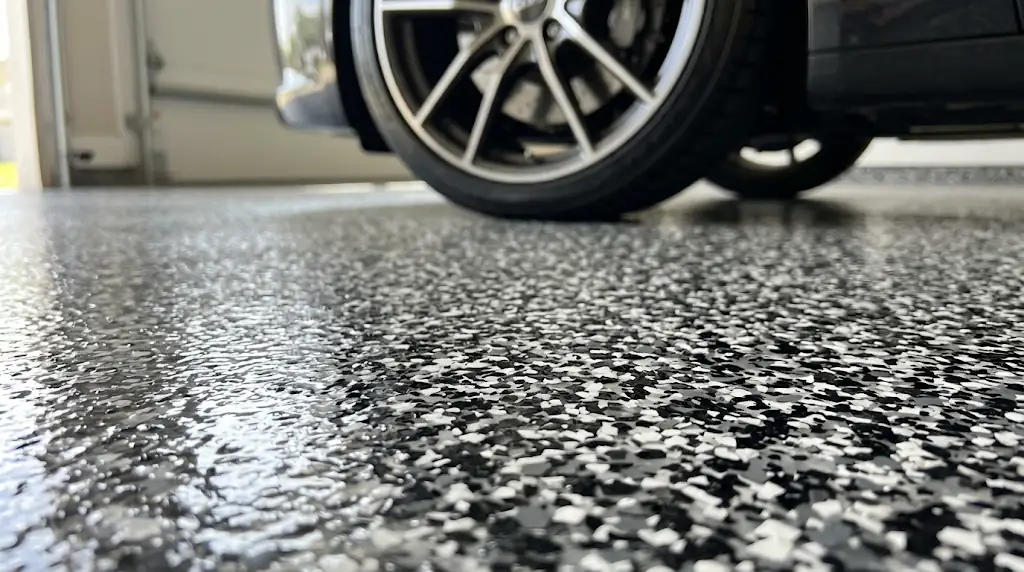
The main difference between epoxy and polyaspartic floors in the Phoenix West Valley is UV stability and curing speed. Epoxy acts as a slow-curing, heavy-duty primer that bonds deeply into concrete pores, while polyaspartic serves as a rapid-curing, 100% UV-resistant topcoat that prevents yellowing and hot-tire peeling.
Homeowners researching garage floor coatings face a barrage of conflicting marketing claims. Some contractors push traditional epoxy, while others heavily promote “one-day polyaspartic” or polyurea floors. Understanding the exact chemical differences between these materials is mandatory when investing in a floor meant to survive the extreme temperatures of Maricopa County. Neither material is inherently “bad,” but using the wrong chemistry at the wrong layer of your floor system leads to catastrophic failure.
The Chemistry of 100% Solids Epoxy
Standard industrial epoxy is a two-part thermosetting polymer. When the resin and hardener are mixed, they undergo a slow exothermic chemical reaction. This slow curing phase—often called a long “pot life”—is the greatest structural advantage of epoxy when used as a base coat.
In the intense heat of the West Valley, concrete acts like a dense sponge. When we apply a 100% solids epoxy to a mechanically ground garage floor in Peoria or Surprise, the slow cure rate allows the liquid resin ample time to physically sink into the microscopic pores of the concrete slab. It wicks downward, filling tiny voids and capillaries before finally hardening. This creates a permanent, root-like mechanical bond that resists extreme hydrostatic pressure and heavy vehicle weight.
However, raw epoxy has two distinct weaknesses:
- UV Degradation: Epoxy is not UV stable. If exposed to the direct Arizona sunlight radiating onto your driveway apron, raw epoxy undergoes a chemical breakdown. Within months, the clear resin will amber, turning a distinct yellow or brown color. It also becomes chalky and brittle.
- Chemical Vulnerability: While strong, standard epoxy can soften slightly when exposed to boiling hot tires or harsh automotive solvents over prolonged periods.
The Chemistry of Polyaspartic Aliphatics
Polyaspartic is a highly engineered derivative of polyurea. Originally developed for commercial steel bridges and industrial applications requiring rapid return-to-service times, polyaspartic chemistry solves the primary weaknesses of traditional epoxy.
The most defining characteristic of an aliphatic polyaspartic coating is absolute UV stability. A polyaspartic clear coat will never amber, yellow, or fade, regardless of how many hours of direct sunlight it absorbs from an open, west-facing garage door in Sun City.
Furthermore, polyaspartic coatings possess incredible cross-linking density. Once cured, the surface is almost completely impervious to chemical intrusion. This means boiling hot vehicle tires cannot transfer their plasticizers into the coating, entirely eliminating the risk of hot-tire pickup.
- Rapid Cure Rates: Polyaspartic cures exceptionally fast. In the 100°F+ heat of a Glendale summer, a polyaspartic topcoat can cure hard enough to walk on in less than two hours.
- Flexibility: Polyaspartic maintains a microscopic level of elastomeric flexibility, allowing it to withstand the thermal expansion and contraction of West Valley concrete slabs without shattering.
- Chemical Resistance: It provides maximum defense against gasoline, brake fluid, battery acid, and road salts.
Comparing Coating Materials
| Feature | 100% Solids Epoxy | Polyaspartic Urethane |
| Primary Function | Deep-penetrating base coat / primer | High-gloss, protective clear topcoat |
| Cure Time (at 75°F) | 12 to 24 hours | 2 to 4 hours |
| UV Resistance | Poor (Ambers rapidly) | Excellent (100% UV Stable) |
| Concrete Penetration | Excellent (Deep root-like bond) | Poor (Flash cures too quickly in heat) |
| Hot-Tire Resistance | Moderate | Extreme |
The Danger of “One-Day” Polyaspartic Floors in Arizona
Many high-volume franchise companies market “One-Day Polyaspartic” systems, claiming to coat your floor from bare concrete to finished product in under eight hours. They apply a polyaspartic primer directly to the concrete, followed by flakes, and a polyaspartic topcoat. In cooler, northern climates, this method is acceptable. In the Arizona desert, it is a massive structural risk.
During the summer, a concrete slab in El Mirage or Youngtown frequently reaches surface temperatures exceeding 130°F. If an installer applies a rapid-curing polyaspartic directly to a 130°F concrete slab, the chemical reaction violently accelerates. The material “flash cures” in a matter of minutes.
Because it hardens instantly upon contacting the hot concrete, the polyaspartic does not have the physical time required to penetrate the concrete pores. Instead of creating a root-like bond, it merely bridges over the top of the surface like a sticker. When a 5,000-pound truck turns its wheels on that floor, the weak surface bond breaks, and the entire coating delaminates.
The Association for Materials Protection and Performance (AMPP) details strict standards for coating adhesion, heavily emphasizing the necessity of substrate penetration over mere surface adhesion in industrial coating applications.
The Ultimate Hybrid System: The Desert Standard
The most durable, scientifically sound coating system for the Phoenix West Valley combines the strengths of both materials into a single, multi-layered application. Professional, permanent installations utilize a hybrid approach.
- The Epoxy Base: A slow-curing, moisture-mitigating 100% solids epoxy is applied directly to the mechanically ground concrete. This layer wicks deep into the slab, creating an unbreakable mechanical bond, entirely ignoring the extreme surface temperatures.
- The Flake Broadcast: Decorative vinyl chips are broadcast into the wet epoxy, providing structure, impact resistance, and color.
- The Polyaspartic Topcoat: Once the epoxy fully cures, the floor is sealed with a pure polyaspartic clear coat. This armor layer locks out the UV rays, resists hot tires, and provides a brilliant, chemical-resistant gloss.
Do not fall for the marketing hype of a one-size-fits-all coating. Protect your concrete with a system engineered specifically for the harsh realities of the desert environment. Contact Surprise Epoxy Flooring for a technical breakdown of our hybrid coating process. Visit our contact page to schedule an accurate slab assessment and discover the exact materials required to build a lifetime floor in your garage.