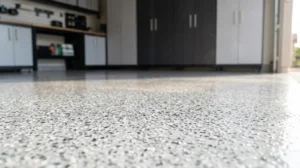
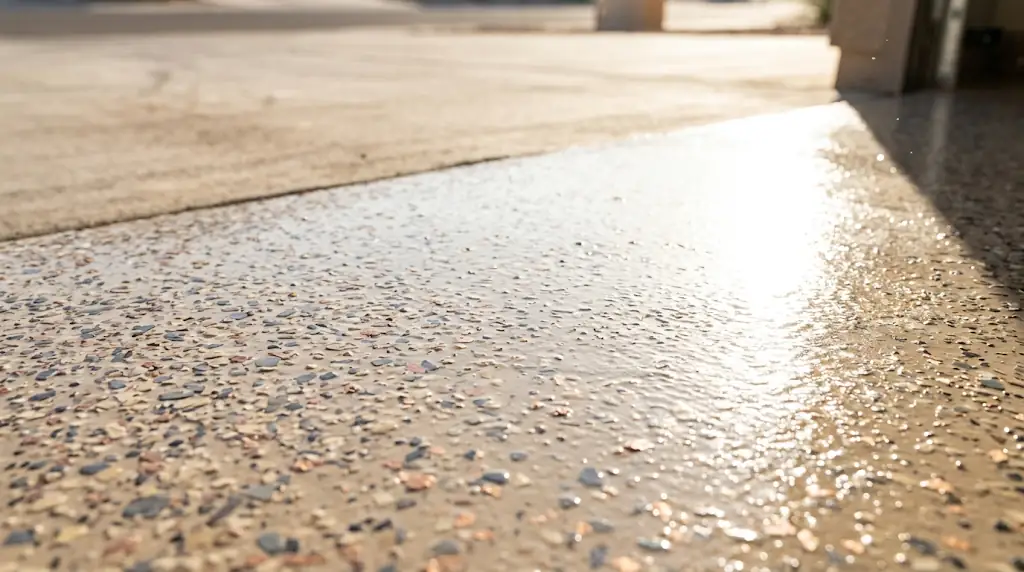
A professionally installed, multi-layer epoxy garage floor in the Phoenix West Valley lasts between 10 and 20 years. Constant exposure to extreme summer temperatures exceeding 110°F requires specialized polyaspartic topcoats to prevent UV yellowing and hot-tire peeling.
The West Valley climate destroys standard floor coatings. Surface concrete temperatures inside unairconditioned, west-facing garages in Surprise and Peoria regularly exceed 140°F in July. Under these conditions, standard 1-day DIY epoxy kits fail within 12 to 18 months. Achieving a decades-long lifespan requires industrial-grade resins, mechanical concrete profiling, and thermal-shock resistance.
The Threat of Hot-Tire Pickup
Hot-tire pickup is the primary cause of epoxy floor failure in Maricopa County. When you drive on black asphalt in El Mirage or Glendale during August afternoons, vehicle tires absorb immense heat. Parking those tires on low-grade epoxy creates immediate thermal shock.
The heat transfers from the rubber into the epoxy resin. As the tire cools, the rubber contracts and grips the softened coating, physically tearing it away from the concrete slab.
- Thermal Expansion: Rubber tires heat up to 150°F on Arizona roads.
- Plasticizer Migration: Chemical compounds in the hot rubber transfer to the epoxy, softening the structural integrity of the resin.
- Delamination: The bond between the concrete and the coating breaks completely, leaving bare concrete patches under the vehicle’s wheels.
Professional applications prevent this by utilizing high-build, 100% solids epoxy primers combined with polyaspartic topcoats. Polyaspartic urethanes possess high cross-linking density, making them impervious to hot tire plasticizers.
Lifespan Comparison: Epoxy vs. Polyaspartic Systems
Not all garage floor systems handle the Arizona heat equally. The chemical composition of the topcoat dictates the true lifespan of the floor.
| System Type | Average AZ Lifespan | UV Resistance | Hot-Tire Resistance |
| Water-Based DIY Epoxy | 1 to 3 Years | Poor (Rapid Yellowing) | Low |
| 100% Solids Epoxy (No Topcoat) | 5 to 10 Years | Moderate (Ambers Over Time) | Medium |
| Epoxy Base + Polyaspartic Topcoat | 15 to 20+ Years | Excellent (Clear) | High |
Concrete Surface Preparation Dictates Longevity
No coating survives if the concrete profile is incorrect. Acid etching is insufficient for the dense concrete mixes found in Sun City and Sun City West homes. The acid merely cleans the surface rather than opening the pores of the concrete.
To achieve maximum adhesion, the concrete must be mechanically ground. We use heavy-duty planetary diamond grinders to achieve a Concrete Surface Profile (CSP) of 2 or 3. This standard is established by the American Concrete Institute, ensuring the liquid resin can physically penetrate and lock into the concrete matrix before curing.
Proper preparation includes:
- Diamond Grinding: Removes the smooth, troweled laitance layer of the top concrete.
- Moisture Testing: Measures Moisture Vapor Transmission (MVT). Even in the desert, hydrostatic pressure pushes moisture up through the slab, which can delaminate coatings.
- Joint Reconstruction: Fills expansion joints, saw cuts, and stress fractures with flexible polyurea filler to prevent future cracking transferring through the epoxy.
Managing Arizona’s Monsoon Moisture
While extreme heat is the baseline challenge, the sudden humidity spikes during the July and August monsoon season disrupt epoxy curing processes. Epoxy requires stable humidity. High moisture levels in the air cause “blushing”—a waxy, oily film that forms on the surface of the curing epoxy. Blushing ruins the adhesion of the final clear coat.
Commercial-grade installations mitigate this by utilizing moisture-mitigating primers and tightly controlling the application environment. Polyaspartic topcoats cure faster and are less susceptible to humidity blushing than traditional epoxies, making them the superior choice for summer installations in the West Valley.
Safe, Low-VOC Materials
Garages in Youngtown and Surprise are predominantly attached to the main living structures. Air quality during the curing process is a critical safety metric. Standard solvent-based epoxies off-gas toxic fumes into the home.
High-quality, 100% solids epoxy systems and pure polyaspartics emit near-zero Volatile Organic Compounds (VOCs). These materials align with the strict indoor air quality guidelines published by the Environmental Protection Agency. The floor cures through a chemical reaction rather than solvent evaporation, leaving no residual odors once fully hardened.
Regional Service Areas and Soil Considerations
Soil composition and local building codes dictate the baseline health of the concrete slab. Expansive clay soils cause slab shifting, requiring specialized elastomeric base coats to bridge micro-fractures in the concrete. We adapt our grinding techniques and moisture barriers based on the specific municipality.
We engineer and install temperature-resistant epoxy flooring across the following regional service areas:
- Surprise, AZ
- El Mirage, AZ
- Sun City, AZ
- Sun City West, AZ
- Peoria, AZ
- Glendale, AZ
- Youngtown, AZ
Achieving a 20-year lifespan out of a garage floor in the West Valley heat requires industrial-grade chemistry and aggressive mechanical preparation. Don’t waste money on a water-based system that will peel after one July afternoon. Connect with Surprise Epoxy Flooring to install a floor engineered strictly for the desert environment. You can reach out directly through our contact page to schedule a precise measurement and technical estimate.